Masticating Juicer vs Centrifugal Juicer: Ultimate Guide
The journey toward a healthier lifestyle often begins in the kitchen, specifically with the vibrant colors of fresh produce. When you decide to incorporate more liquid nutrition into your daily routine, you inevitably face the ultimate debate: masticating juicer vs centrifugal juicer. While both machines aim to extract liquid from fruits and vegetables, they use fundamentally different mechanical processes to achieve that goal. Understanding these differences is crucial because the choice affects everything from the nutritional density of your hydrating morning beverage to the amount of time you spend scrubbing parts at the sink. Whether you are looking for a quick refreshing boost or a long-term wellness investment, the technology behind your juice matters.
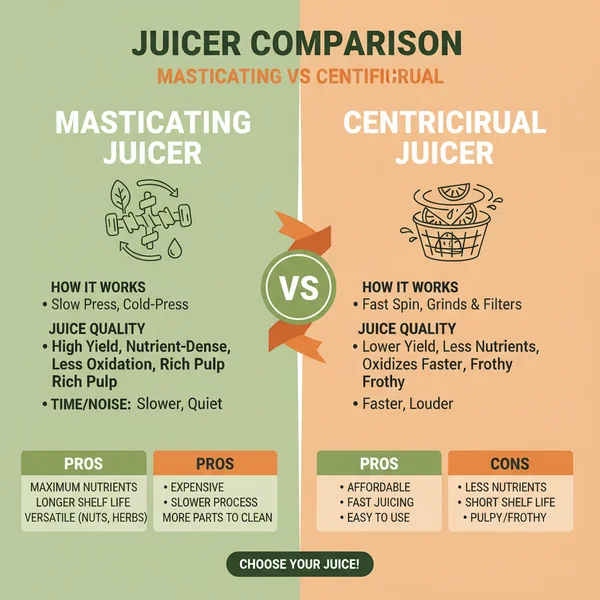
The masticating juicer is the winner for those prioritizing nutrient density, juice yield, and the ability to process leafy greens. However, if you are a beginner on a budget who needs a chilled glass of juice in under two minutes, the centrifugal juicer remains the most practical and accessible choice.
Comparison Table
| Feature | Masticating (Slow Juicer) | Centrifugal (Fast Juicer) |
|---|---|---|
| Mechanism | Slow-turning auger (chewing) | High-speed spinning blade |
| RPM Range | 40 – 100 RPM | 3,000 – 15,000 RPM |
| Juice Yield | High (especially for greens) | Moderate (pulp is often wet) |
| Heat/Oxidation | Minimal (Cold-pressed) | Higher (Due to speed/friction) |
| Noise Level | Very Quiet | Very Loud (Like a blender) |
| Prep Time | High (Requires small cutting) | Low (Large feed chutes) |
| Shelf Life | Up to 72 hours | Consume immediately (24 hours max) |
Detailed Analysis
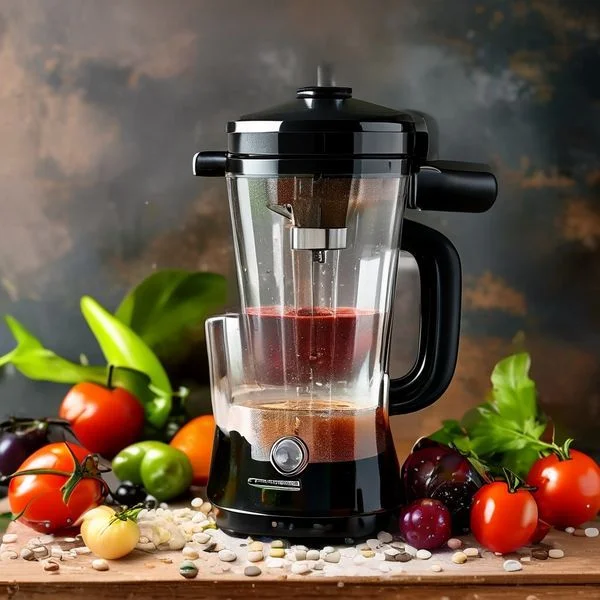
To truly understand the masticating juicer vs centrifugal juicer debate, we must look at the science of extraction. A centrifugal juicer works much like a blender combined with a sieve. It utilizes a flat cutting blade at the bottom of a rapidly spinning strainer basket. As produce is pushed down the feed chute, the blades pulverize it into a mash. Centrifugal force then hurls the mash against the mesh walls, separating the liquid from the fiber. While this process is incredibly fast, the high-speed spinning introduces significant amounts of oxygen into the juice. This oxidation leads to faster degradation of enzymes and nutrients. If you’ve ever noticed a thick layer of foam on top of your refreshing apple juice, that is a direct result of the aeration inherent in centrifugal models.
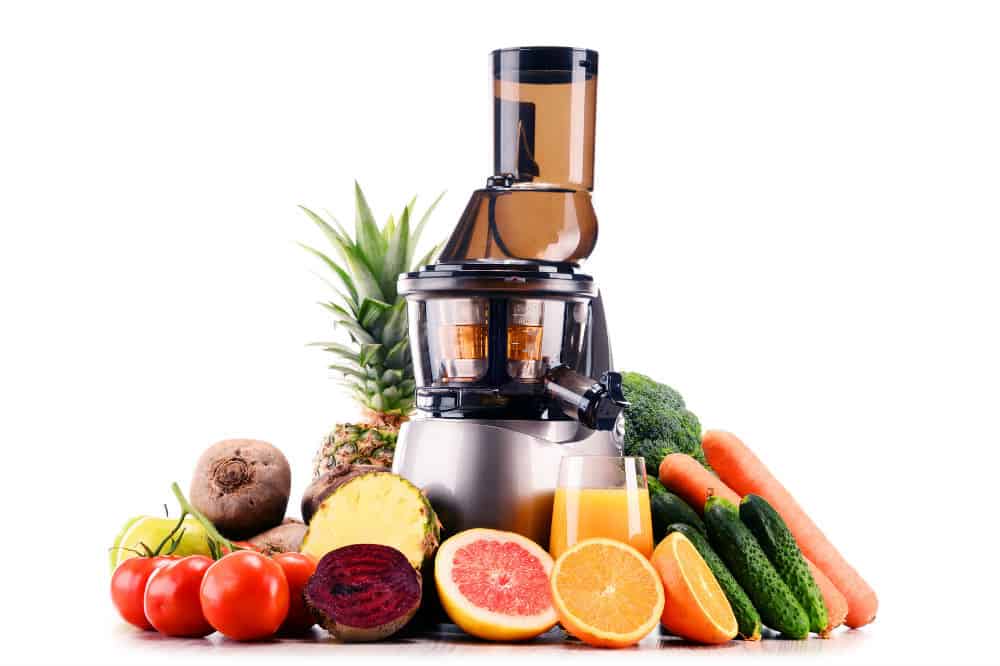
On the other hand, the masticating juicer (often called a “slow juicer” or “cold-press juicer”) mimics the human action of chewing. It uses a screw-like auger to slowly crush the fruits and vegetables against a stainless steel screen. Because it operates at very low RPMs, it generates virtually no heat and minimal friction. This preserves the delicate phytonutrients and live enzymes found in produce. Furthermore, masticating models are far superior when it comes to leafy greens like kale, spinach, and wheatgrass. While a centrifugal unit might spin a leaf of kale right into the pulp bin without extracting a drop, a masticating unit will squeeze it dry, ensuring you get every bit of hydrating liquid possible.
One major distinction lies in the texture and shelf life. Masticating juicers produce a juice that is dense, rich, and less prone to separation. Because the oxidation is so low, you can store this juice in a chilled, airtight glass jar for up to three days. Centrifugal juice, conversely, separates quickly—often within minutes—into layers of water and solids. It is best enjoyed immediately over ice to maintain its crisp flavor. While the centrifugal juicer is faster to use due to its wide feed chute (often allowing whole apples), the masticating juicer requires more prep work, as produce must be chopped into smaller pieces to avoid clogging the auger.
Maintenance is another factor to consider. Centrifugal juicers often have large, bulky parts and a fine mesh basket that can be difficult to scrub clean. Masticating juicers vary; horizontal models have several small parts, while newer vertical “self-cleaning” models have simplified the process significantly. However, both require consistent care to ensure that no frozen residue or dried pulp builds up in the delicate screening areas.

When to Choose Each
Choosing between these two machines depends entirely on your lifestyle, patience, and health goals. There is no one-size-fits-all answer, but there are clear scenarios where one outperforms the other.
Choose a Centrifugal Juicer if:
- You are a busy professional who only has a few minutes in the morning to prepare a refreshing drink.
- You are on a budget and want to start juicing without a heavy initial investment.
- You primarily juice hard fruits and vegetables like carrots, apples, and beets.
- You prefer a juice that is thin and light, served immediately over ice with a simple lemon garnish.
Choose a Masticating Juicer if:
- You are a serious health enthusiast who wants the maximum concentration of nutrients and enzymes.
- You want to juice leafy greens, herbs, or even frozen fruits for sorbets (many masticating models include a blank attachment for this).
- You prefer “batch juicing” on Sundays to have hydrating drinks ready for the next 48 to 72 hours.
- You value a quiet kitchen environment; masticating juicers won’t wake up the whole house like a high-powered blender or centrifugal motor would.
If your goal is sustainable wellness, I recommend investing in a vertical masticating juicer. While the price point is higher, the increased yield and nutrient quality mean you spend less on produce in the long run. To make the juice even more palatable, serve it chilled and add a sprig of mint as a garnish to enhance the sensory experience.
Conclusion
Ultimately, the masticating juicer vs centrifugal juicer debate comes down to quality versus convenience. A centrifugal juicer is the “fast food” of the juicing world—quick, easy, and effective for those on the go. The masticating juicer is more akin to “slow cooking”—it takes time and preparation, but the results are undeniably superior in flavor, texture, and nutritional value. For a truly hydrating and refreshing experience that supports your long-term health, the slow extraction of a masticating juicer is the gold standard. However, the best juicer is the one you will actually use every day.
❓ Frequently Asked Questions
1
How long does fresh juice last in fridge?
Cold-pressed juice from a masticating juicer can last up to 72 hours when stored in an airtight glass container. However, juice from a centrifugal juicer is best consumed within 24 hours because the high-speed blade introduces heat and oxygen, which causes the nutrients to degrade much faster.
2
Can I make juice ahead of time?
Yes, you can make juice ahead of time, but it is highly recommended to use a masticating juicer for this purpose. These machines minimize oxidation, allowing the juice to remain refreshing and nutrient-dense for a few days. Always fill the container to the brim to reduce air exposure.
3
What can I substitute for a juicer?
If you do not have a juicer, you can use a high-speed blender to pulse your fruits and vegetables into a puree. Once blended, pour the mixture through a nut milk bag or fine-mesh strainer to remove the pulp. This creates a hydrating juice similar to a machine.
4
How do I know when the juice is done?
The process is complete once no more liquid is dripping from the discharge spout and the expelled pulp looks relatively dry. For centrifugal models, this happens very quickly. For masticating models, it takes longer as the auger slowly presses every drop of hydrating liquid from the plant fiber.
5
Can I freeze fresh juice?
You can freeze fresh juice for up to three months without losing significant nutrients. Leave some space at the top of the container for expansion as it freezes. Thaw it in the refrigerator overnight and give it a good shake before serving it over ice for a refreshing beverage.